One thing is clear: most tech challenges aren’t technical. They’re about people, communication, and collaboration. The real skill is knowing how to work together to find solutions.
About me
I am Carita Niskanen. I currently work as a Solutions Architect at Amazon Web Services (AWS) in Helsinki. I joined the company in December 2022. Before AWS, I spent almost 20 years working as a software developer.
My role as a Solutions Architect
At AWS, a Solutions Architect is best described as a technical guide for customers. As AWS has a large portfolio of services, one of our main responsibilities is helping customers navigate AWS resources, understand which services make sense for their use cases, and design architectures that are secure, scalable, and cost-efficient.
One of the most interesting parts of my role is acting as a bridge between customers and AWS service teams. If a customer is facing a specific challenge with a service, we can bring in the people who have actually built that service. That creates direct, meaningful conversations where feedback flows both ways, and where customers gain insights they wouldn’t normally have access to. This is where AWS really shines: the distance between users and builders is surprisingly short.

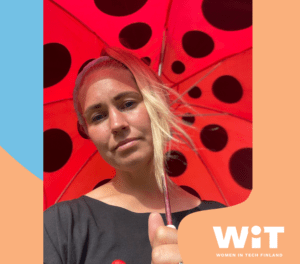
Carita Niskanen, Solutions Architect, AWS
My path to AWS
For years, I was coding on top of AWS. The more I worked with cloud services, the more certain I became: I loved the cloud. The architecture, the building blocks, the freedom to design and experiment, this was where I wanted to be.
When an ex-colleague encouraged me to apply, I knew the interview process would be intense. And it was. A full day. Deep preparation. No shortcuts. At some point, the question was: Do I want this enough to fully commit to a long interview process, without knowing the outcome? I did.
The AWS’ culture is excellent. Smart, generous colleagues. Open discussions. A strong sense of ownership. It’s demanding and very different from anything I’ve experienced before. That combination is why I’m still here. The opportunities inside AWS are endless.
The beginning of my tech career
My interest in tech started very early in my life. When I was around 10, my sister and I got a computer where we played games, typed commands, and later even built PCs from parts, upgrading memory and understanding how components worked together. That early exposure made technology feel familiar, not intimidating.
After high school, I took a gap year to figure out my direction. I loved math, but IT clicked: programming, problem-solving, and real career opportunities. So I went for it. Growing up, I never thought IT wasn’t an option for me. I had strong female role models in my family and constant support. The idea that “you can’t do this because you’re a woman” simply wasn’t part of my world.
Years later, one thing is clear: most tech challenges aren’t technical. They’re about people, communication, and collaboration. The real skill is knowing how to work together to find solutions. That early curiosity and the confidence to try still drive me today.
Tips to Overcome Challenges
Most problems don’t get solved by forcing solutions. Some of my best answers, in tech and in life, have arrived when I stopped thinking about the problem altogether. The brain needs space to do its work. When things get hard, it’s time to step away. I’ve learned the hard way that staring at a problem rarely solves it; it usually just drains your energy.
What works for me is disconnecting. I spend time outdoors. Golf is one of my resets. More recently, I started birdwatching. It has the same effect as golf. Being outside, fully present, observing nature. I live in the center of Helsinki and was surprised to discover over 30 bird species right here in the middle of the winter. That sense of wonder, noticing what’s been there all along, is powerful.
And then there are jigsaw puzzles. No talking. Just focus. Music or an audiobook in the background, and total immersion. It’s the kind of activity where “one more piece” suddenly turns into 2 a.m.
My point of view of AI
AI has massive potential. I use it in the areas where I know I’m not strongest, like writing. I can write, sure. But when something is going public, I know it’s not my core superpower. That’s where AI becomes a collaborator: it gives me a solid draft, and I refine it.
Lately, I keep hearing: “If AI can write all the code, why do we need developers?” That line of thinking is risky. AI makes mistakes. It always will. It’s a powerful tool, but still just a tool.
I’m optimistic about AI. It will absolutely shape the future of work. But I don’t believe it replaces human judgment, experience, or responsibility. If AI produces something wrong, you still own the outcome.
My real concern? The next generation entering the job market. Many won’t know what it’s like to work without AI. So how do we help them build the intuition, scepticism, and responsibility needed to work with AI, without blindly trusting it?
Learning in a constantly changing field
I’m often asked where I go to keep learning. Podcasts? YouTube? Some must-follow sources? Honestly, none in particular.
I stay close to what’s happening through news, conversations, and the flow of information around me. At AWS, there’s a constant exchange of insights internally, which shapes much of my understanding of the market.
And then there’s LinkedIn. People there are incredibly active, curious, and generous with ideas. My feed is full of voices from different backgrounds, and many of those posts genuinely make me stop and think.
Discrimination in the IT field
I, as many other people, have faced discrimination in the tech field. If you’re a woman in IT, and someone asks you if she has faced this problem the honest answer is usually: yes.
Early in my career, I was working on a customer project. I arrived five minutes late to an architecture meeting with another female colleague because our previous meeting ended five minutes late. We apologized and sat down. Everyone else in the room was male.
A man from another consultancy smiled and said:
“That’s totally fine, girls. You can do a background dance while we design the architecture.”
Then he laughed. Loudly. The room went silent. Eyes down. No one said a word. What struck me even more? That comment was the only thing he contributed. When it came to the actual architecture, he had nothing to add.
I didn’t respond in the moment, but I did escalate it. My employer took it seriously and raised it with the customer. Because this wasn’t a joke, it was disrespectful, unprofessional, and harmful.
I’ve heard other comments too.
“This is the girl’s code.” “Relax, it’s just a joke.” It never is.
Things have improved over time, maybe because the industry is changing, maybe because experience reduces how easily people try to undermine you. But those moments don’t disappear. You remember them clearly. Exactly as they happened.
My favorite books and quotes
When it comes to reading, that’s a different story. I read a lot. Last year, I read around 70–80 books. Mostly fiction.
One book that truly stayed with me is Piranesi. One of those books that quietly rearranges something in your head. As for quotes, my mind always goes to The Shawshank Redemption: “Get busy living, or get busy dying.” It’s simple, but powerful. You’re responsible for your life. For choosing direction. For being brave enough to move toward what you want.