As technology reshapes how we live, work, and connect, we need communities that build trust, courage, and belonging. In an age of polarisation, inclusion isn’t a soft value — it’s how we build better businesses, stronger industries, and more resilient societies.
At Teknologia25, Women in Tech Finland hosted a timely conversation on leadership, belonging, and courage in an era defined by change. The discussion brought together Piia Simpanen and Pia Erkinheimo — two of the five founders of Women in Tech Finland — alongside Jussi Herlin, Vice Chair of the Board at KONE, one of WiT’s earliest member companies. Moderated by Katja Toropainen, CEO of Inklusiiv, the team behind Women in Tech, the panel explored how the movement began, what inclusion means in today’s context, and why communities like WiT remain essential to the future of technology.
From a spark to a movement
When Piia Simpanen and the event organising team first booked Dipoli Hall for what would become the first Women in Tech Forum in 2013, they expected a hundred and fifty people. Four hundred showed up. “We realised immediately there was a real need for this,” she recalled. Her co-founder Pia Erkinheimo remembers the early days vividly. “I didn’t want to be labelled as a ‘woman in tech’ or a ‘female leader,’” Pia reflected, “but I knew this was important, and that there was a real business case for diversity.”
The first event’s success made one thing clear: people needed a place to connect, learn, and see themselves represented. As Piia puts it, “One participant said after the event, ‘Finally, I feel like I’m not alone anymore.” What began as a one-off event turned into a growing network and, over time, a movement shaping the Finnish tech industry’s approach to inclusion. The early decision to make WiT events free and open to all was about more than accessibility — it was about signalling that tech is for everyone.
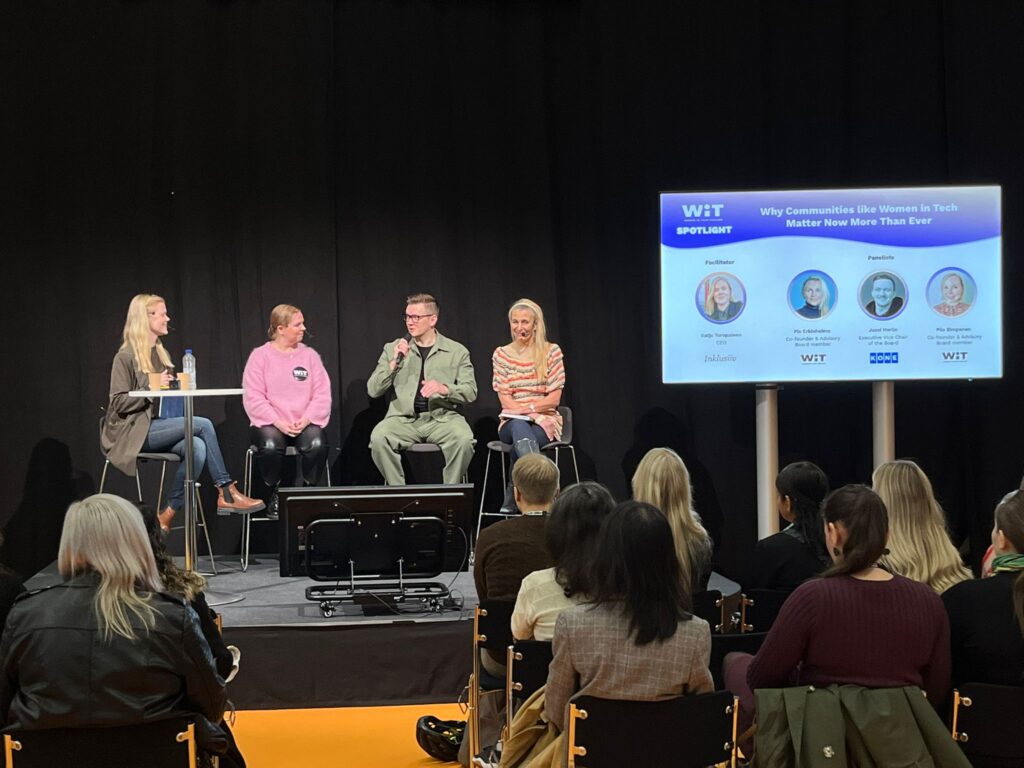
Katja Toropainen, CEO of Inklusiiv, Piia Simpanen, co-founder of WiT Finland, Jussi Herlin, Vice Chair of the Board at KONE and Pia Erkinheimo co-founder of WiT Finland
Leading with courage
A decade later, Piia reflects on what has changed — and what hasn’t. Now working as a DEI leader at Telia, she speaks openly about the vulnerability that leadership requires. “When I was asked to lead diversity and inclusion, I said yes immediately. And then I was terrified — afraid I’d say the wrong thing or not be good enough.”
That fear, she explains, is exactly why psychological safety and peer support matter. “Silence worries me. If we’re silent, we can’t go further. We can only grow when we have the courage to raise uncomfortable topics, together.”
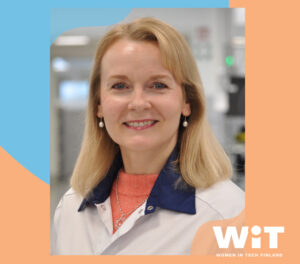
Pia Erkinheimo, who is now an active investor and board professional, pointed out that diversity in tech goes far beyond gender or STEM. “Technology needs historians, designers, social scientists, philosophers,” she said. ““When gender diversity grows, so does diversity in education and thought. ”
In her work with venture capital, Pia sees both the progress and the gaps. Gender equality has improved in some areas, but in others, such as VC funding, change is still painfully slow, and women still make up a fraction of investors in many European funds. “There are pockets where things are moving in the right direction,” she noted, “and others where they are not.” For Pia, the past decade has made one thing clear: tech’s biggest challenges won’t be solved by engineers alone.
The role of allies and the future of belonging
Jussi Herlin, Vice Chair of the Board at KONE, one of WiT’s earliest member companies, offered a thoughtful view on what it means to be an ally in today’s tech landscape. Having attended Women in Tech events since the early years, he recalled that in the beginning, the rooms were filled almost entirely with women. It took time for more men to join and engage in the conversation.
For Jussi, the conversation about equality and leadership is inseparable from the larger crisis of trust in society. He spoke about how today’s algorithms, ad-based revenue models and attention-driven systems often reward outrage, amplifying division rather than understanding. In that context, communities like Women in Tech serve a vital role as spaces for rebuilding trust, both within workplaces and in society at large, where genuine dialogue can happen.
Jussi’s reflections also touched on the future of work. As technology evolves, he noted, traditional power dynamics and skills are shifting, perhaps even moving away from historically male-dominated areas like software and engineering towards art, humanities, care, and new emerging fields. This shift underscores why inclusion is not just about fairness, but about the ability to build systems that reflect the full range of human capability.
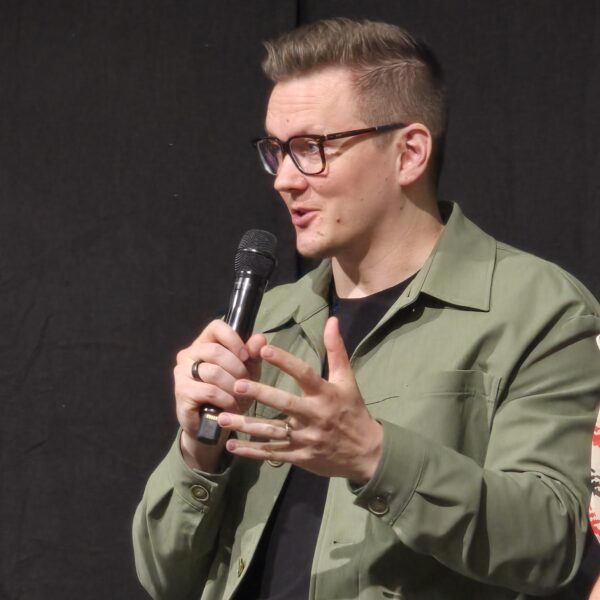
Jussi Herlin, Vice Chair of the Board, KONE
The courage to keep showing up
As geopolitical tensions rise and technology evolves faster than regulation or ethics can keep up, the role of communities like Women in Tech becomes even more critical. They bring together people to make sense of change, challenge bias in emerging technologies, and ensure that progress doesn’t leave anyone behind. The systems shaping our world, from AI models to data infrastructure, need to reflect the societies they serve.
WiT Spotlight: The future of AI and software development
As part of the Women in Tech Spotlight stage programme at Teknologia25, Saana Eriksson, Vice President of Gaming Product Development at Veikkaus, offered a sharp and forward-looking view of how artificial intelligence is reshaping the craft of software development.
Drawing on her experience leading product development at Finland’s state-owned gaming company, Saana described how AI is not just a new tool in a developer’s workflow but a force fundamentally redefining it. Referencing Gartner’s Hype Cycle for Software Engineering 2025, she highlighted a number of emerging technologies still early on the curve — from AI-native software engineering to vibe coding, where human creativity and machine intelligence blend in intuitive ways.
AI, she argued, will transform not only how code is written but how teams think, build, and solve problems together. In the future, AI agents will act as proactive collaborators who anticipate needs, suggest solutions, and co-create with human developers. Saana encouraged anyone working tech to embrace the evolving relationship between people and intelligent systems.
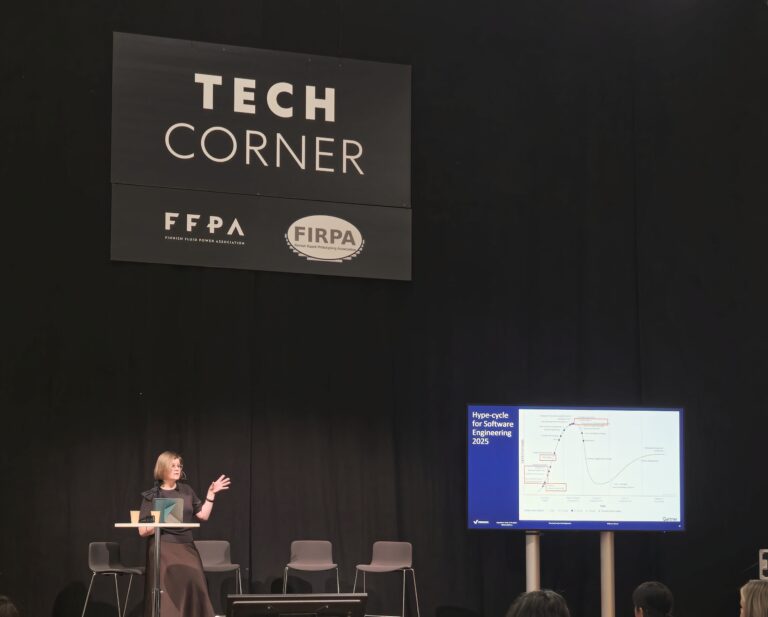
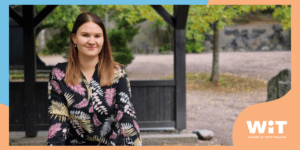
Saana Eriksson, Vice President of Gaming Product Development, Veikkaus
Looking ahead
More than ten years after that first surprise crowd at Dipoli, Women in Tech Finland stands stronger than ever, with record-high membership and a community that continues to evolve alongside the industry it serves. The mission remains the same: to foster a more diverse and inclusive tech industry by offering spaces and opportunities for people to participate, progress in their careers, and be recognised as professionals and leaders in tech.
Join the movement
Help shape a more inclusive tech industry with Women in Tech Finland.
Become a partner company or join as an individual to connect, share ideas and take part in our events, there’s a place for everyone in our vibrant community.