“You’re never finished, you’re never done learning.” Even after school ends, embracing lifelong learning keeps work interesting, challenging and inspiring.
About me
I’m Lotta Laukkanen, a somewhat artsy software engineer and career switcher. I graduated from Metropolia University of Applied Sciences with a bachelor’s degree in May 2021. I joined my current company Digia in October 2023 and immediately got to work on a project where I have learnt countless new things and very thoroughly tested my wings in a variety of areas from UI design to CI/CD.
I come from a background in arts and culture, having made theatre props before transitioning to IT and earning a bachelor’s degree in the field. Yet, I feel that the most relevant and useful lessons only came once I entered the industry and even now, I’ve barely scratched the surface.
From Props to Code
I decided very young that I wanted to become an artist and over time that dream refined into becoming a propmaker, following in my dad’s footsteps. I’ve always loved being creative, solving problems and puzzles, and making functional yet visually pleasing items. Still, the engineering mindset was always there — so much so that I sometimes got engineer jokes as feedback on my art.
“Making it” in arts and culture is hard and uncertainty is part of reality, regardless of degrees one may hold. Many people in those professions feel like their passion outweighs the hardships, but after studying propmaking and working in the field for a while, I felt like I wanted something a bit more stable. The IT career idea started as a joke, but I quickly realised that’s something I’m genuinely interested in and probably would enjoy doing as a full time job. Not to mention, I realised it could also combine all of my favourite aspects of propmaking: problem solving, puzzles, functional and visually pleasing end products.
When I decided to make a complete U-turn to study engineering as an adult, my father fully supported the idea, and reminded me that it’s okay to uproot your career and do something different. He himself switched from engineering to theatre props and scenography. In a way, I’ve followed in my father’s footsteps in my career choices, but backwards.

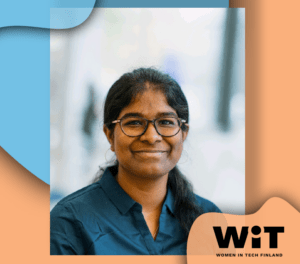
Lotta Laukkanen, Software Developer, Digia
Photographer: Helene Lindfors, Director: Anae
Fullstack, Not Just “Designer Girl”
Like many other women in tech, I have also faced many challenges that I likely would have avoided had I been a man. I also feel that, combined with my earlier studies, people sometimes assume I’m only interested in visual design and that visuals are my strongest suit.
While I do enjoy UI/UX design and have a bizarre interest in tweaking CSS, I can and want to do fullstack development. Breaking free from the explicit “designer girl” label imposed on me has been a recurring theme throughout my career and I suspect it won’t be going away anytime soon. A few years ago, I was at real risk of being stuck in that role, but starting in my current position allowed me to move beyond it.
Looking ahead, the next challenge — like for everyone in IT — is the rise of AI. AI tools can feel strange and intimidating,raising valid concerns about employment, climate and security. But, as with many new developments in this field, part of the discomfort comes from stepping out of the comfort zone of familiarity. Eventually, I think we’ll look back on this moment and wonder whether our apprehension was truly warranted.
My Work at Digia
I work as a fullstack developer on a customer project within a close-knit team. When I was recruited I was told that in this team “everyone does everything”, but I don’t think I truly grasped the meaning of what that meant until I actually started working. In practice, it means that I don’t only code fullstack, but also plan, design, communicate with the customer, write and run tests and handle countless other tasks related to software development and maintenance.
This position and project have been incredibly fulfilling for my career, because the “everyone does everything” mentality constantly pushes me to grow. Sometimes it forces me out of my comfort zone when I come across something completely new, but truthfully, it’s better to dive in and learn than always fall back on what I’m already strong at. It has also given me a general understanding of the entire software development process, something that is hard to grasp without being fully involved in the work.
Skills from Both Worlds
My bachelor’s studies gave me a solid foundation in important programming languages, as you might expect. But the most valuable lessons weren’t just technical. I learned how I learn best and which methods work most efficiently for me, and I understood that it’s okay to be bad at something at first, the key is having the bravery to try anyway.
In the end these are the most valuable skills in IT, because the technology evolves rapidly and professionals need to constantly move along with the progress.
In addition to these, I have a couple of skills from previous work in arts and culture that make my skillset unique. In addition to programming, I can design a functional and visually pleasing UI, conduct user testing and iterate product development based on feedback. I also have skills and experience working with people from various backgrounds. All of these have proven to be valuable assets in my career so far and are the reason I firmly believe that all and any studying and experience pays off in some way.
Community at Digia
I joined Digia in October 2023 and have enjoyed working here so far. I rarely work with people outside my project team, so it’s crucial that our team works well together. In this type of consulting job you often end up working more closely with the customer’s employees than with colleagues from your own organization when you are allocated to a project. That’s what I expected when I joined the company and that hasn’t felt unusual at all.
I enjoy working remotely and really appreciate how flexible Digia has been about remote work. Most of my day is spent working independently, and when we do need to work together, screen sharing is often more effective than everyone crowding around a single monitor. Occasional community-building office days are nice, but most of the time I’m clearly most efficient working from my home office. Having the freedom to choose the way you work best truly makes a big difference.
Despite the separation of different teams and people working remotely, we have some company-wide activities that employees are encouraged to take part in, both for competence development and recreation.
Employee-lead events and activities like these are important to me and make me feel more included in the work community. This is especially important in a large organization like Digia where it would otherwise be easy to just fade into the background and stay at a distance.
For example, the diversity initiative hosted Pride-themed afterwork events in June in two locations. I myself recently took the lead of the after-work culture club, which supports participation in cultural events such as concerts, theatre plays and exhibitions. Our next club excursion will be a Christmas concert, where a group of Digians will go together to enjoy some choir music before the holidays. In addition, competency-building groups organize events and meetings around topics like design, project management or AI tools.
Why Diversity Matters
I have a dream of being able to inspire other women and girls to study tech. I know it’s not easy with all the prejudice still present in the industry, but even before choosing tech, girls are often discouraged from being interested in “mathematical” sciences. I put that in quotes because, most of the time programming and tech in general is not about math, but logic and creative problem solving. These are skills many girls are naturally good at and could thrive in tech, yet they often get discouraged simply because they don’t love numbers.
If we rebranded tech as creative problem-solving instead of math-based hard science, we could attract more creative thinkers and women into the field. I could easily go on a tangent about mathematics and girls in elementary school, but I’ll leave it at this: my biggest support for being interested in math came from my father and brothers, rather than from teachers or the school system.
What keeps me in tech is the endless possibilities and challenging myself constantly – despite it being uncomfortable at times – and the creativity this work requires. I don’t see myself leaving the field anytime soon unless I end up stuck in a role that stops being fulfilling or the industry moves backwards on equality issues. People naturally enjoy learning and want to feel appreciated, and I believe these are key factors behind the industry’s leaky pipeline.
Especially now, with AI taking up more space, we shouldn’t forget the human side of this industry and what motivates people. The openness and eagerness to learn that this field requires can sometimes lead people to switch careers, but I think that should be met with compassion. After all, if the engineer decides to become a theatre scenographer for a while, they may still return to tech with a completely new and irreplaceable skillset.
Equality and diversity in the industry have come a long way over the past decades, but recent developments pose a real threat to that progress globally. The stereotypes and sexism I have faced since the late 2010s have been mild compared to some senior colleagues’ experiences and while I hope that the future generations of juniors will face it even less, I’m honestly worried. We must push back against these DEI rollbacks and rise of misogyny, because this industry needs people from diverse backgrounds to bring out the best ideas and solutions and refine them to the highest success. That won’t happen if half the population is assumed to be less than because of their gender.
What Inspires Me
When it comes to inspiration, I’m totally on the true crime bandwagon. While true crime is popular, I find the wildest and most movie-worthy stories come from cybersecurity. The Kyberrosvot podcast has offered me several fascinating stories of epic heists and cons, both entertaining and informative at once.
Learning never stops in tech and I rely on online resources like Stack Overflow whenever I get stuck. For cloud certifications, the free materials on Microsoft Learn have been incredibly useful.
Many talented and amazing women have disappeared from history simply because they were women. That’s why I find Tove Jansson so inspiring: she was a queer Nordic woman whose work is widely known and loved all over the world today. I aspire to embrace the same creative weirdness, and be surrounded by a wide network of equally quirky friends and acquaintances and, hopefully, inspire others to authentically be themselves and embrace their own strengths..
Stories and imagination have always mattered to me, which is probably why The Lord of the Rings has remained one of my favourite books. I grew up with Tolkien and will always love Middle-earth.
And finally, a piece of advice I try to live by: “You’re never finished, you’re never done learning.” Even after school ends, embracing lifelong learning keeps work interesting, challenging and inspiring.