The main stage, session by session





Five highlights from Forum 2026
Keep thinking, even when AI makes it easy not to
AI has taken away the friction that used to make us stop and think. Shay Strong (ICEYE) called this exactly the risk: “ultimately you cannot understand the impact of decision you didn't make.” Her answer isn't to avoid AI, but to “add back friction where the radius demands it.”
The concern came up again in the panel “The Next Tech Frontier”, straight after Shay's talk. Cristina Andersson called our “cognitive sovereignty” the biggest question right now, and left the audience with a simple instruction: “Take care and nourish your cognition.” Mona Dash (Infosys) put it plainly: “The worry is more about if humans stop thinking.”
The panel “FOBO and Technostress” looked at what all this speed does to people. For Elina Ojala (Knowit), the biggest fear in her team wasn't losing their jobs, “it was falling behind”. When AI started saving time, her team chose to put it into learning together. Mari Laukkanen (Accenture) warned against confusing resilience with overload: “resilience is not the same as doing lots of work.” Or, as Elina put it: “we are accelerating but what are we accelerating for?”
Hype is expensive. Trust is the real currency
Overpromising has a price, said Emilia Stuart (IQM). When hype runs ahead of reality, money goes to the wrong places, people lose time and sometimes their jobs, and trust erodes for the next real breakthrough. Her lesson from writing about quantum computing: “In order to say very little, you have to know a lot.” Before believing any claim, she asks three questions: compared to what, who has checked it, and useful for whom and by when?
Neeta Nagar (Accenture) showed that the cost is measurable too. In an Accenture survey of almost 700 executives across 17 countries, leaders could explain only 20% of what they were spending on AI tokens: “80% was a lost cost in the system.” On the panel, Mona Dash (Infosys) named trust as what decides whether AI gets adopted at all: “Unless you trust a technology, the adoption cannot be as good.” For Jarmo Sareva (Ministry for Foreign Affairs of Finland), trust is one of Europe's biggest strengths: “Trust is really key to making a happy and productive society.”
Satu Kiiskinen (Vivicta) showed what trust looks like from the inside, after leading 7,000 people through two years of not knowing whether their business would be sold, listed or kept: “Leadership is not about pretending to have certainty. It is all about creating enough clarity, enough direction and trust for people to keep moving when certainty does not exist.”
Agents need people who see the whole picture
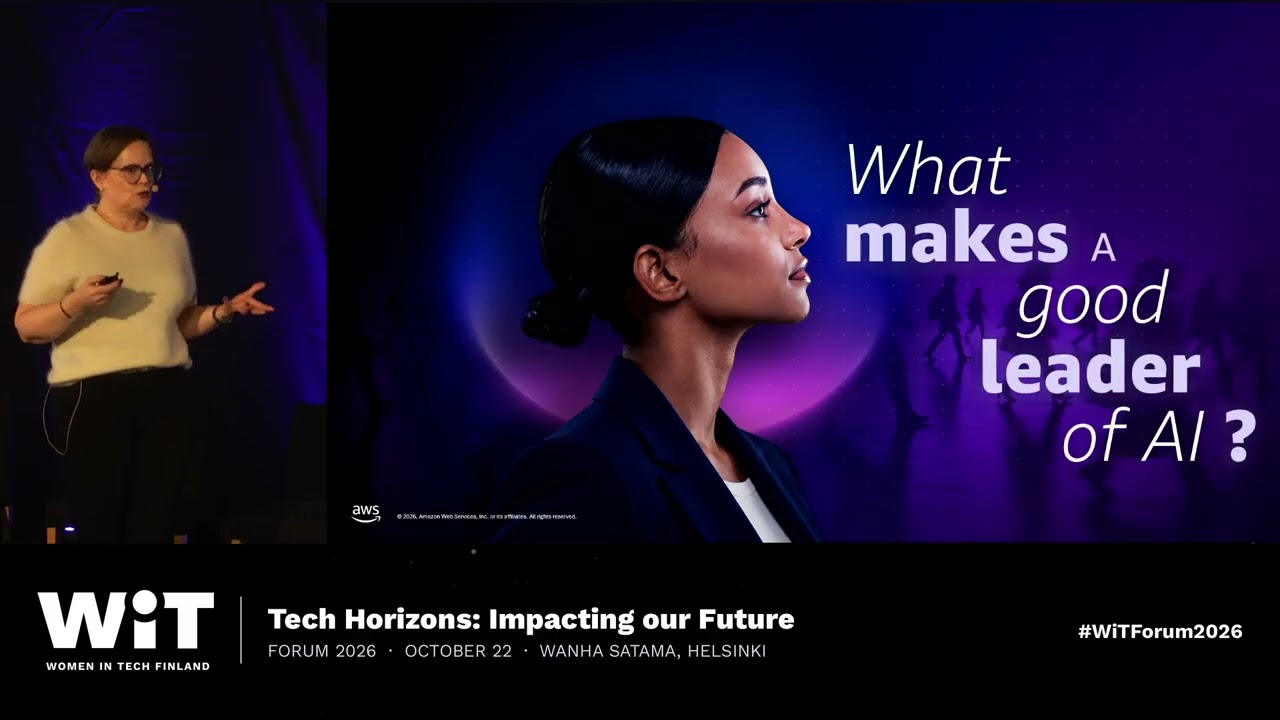
Agentic AI was everywhere on stage, but no one described it as a shortcut. Marianna Saarinen (AWS) said AI “shouldn't be just a tool”, and that leadership is about “the people who can put the right agents on the right places”: people who understand both the technology and the business, and know when a human needs to step in. Mona Dash (Infosys) warned that we're overestimating autonomous agents, and that “what we're underestimating is the boring stuff”: data, governance and security.
Neeta Nagar (Accenture) counted 41 new AI models launched in a single month, and asked whether we keep chasing them, “or do we make our own decisions around it”. Her answer: “The goal should not be to keep up with the AI.” The value comes from getting the data and foundations right, not from building agents for their own sake.
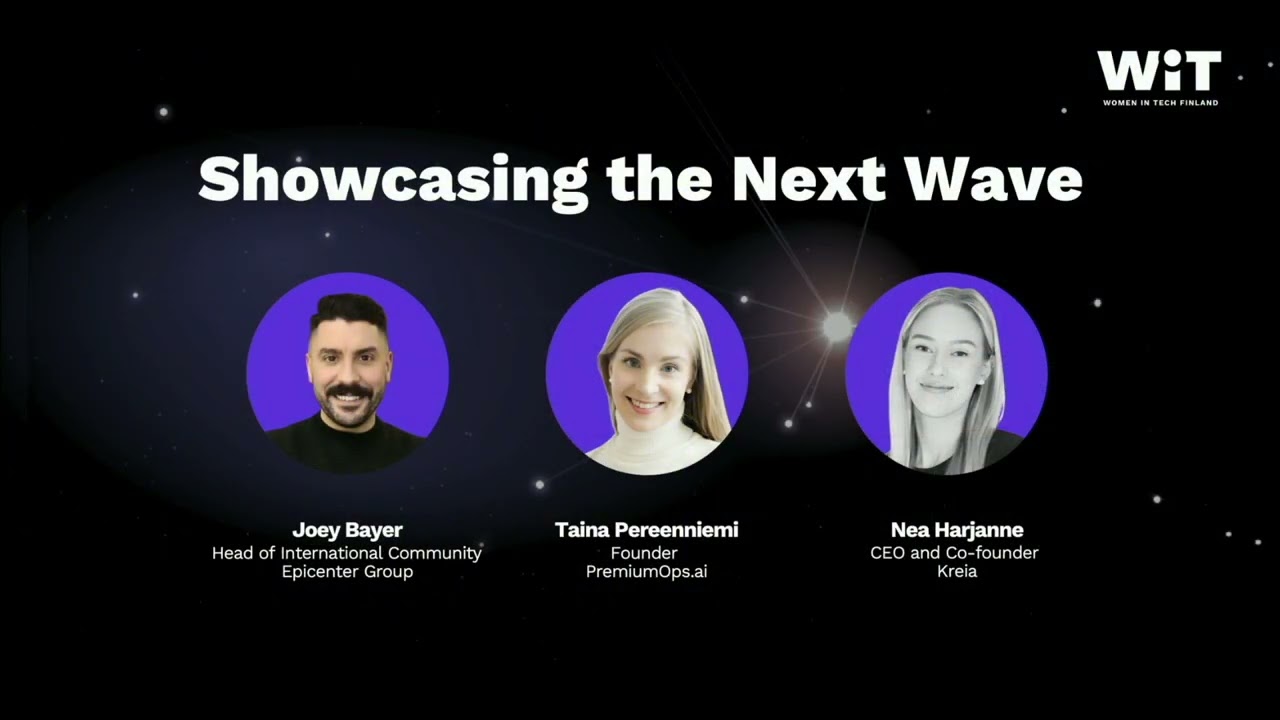
Taina Pereenniemi (PremiumOps.ai) showed what that looks like in practice. As a solo founder, she runs her company with a team of AI agents, where every agent gets a role, a boss and a mandate. In her view, AI is “turning everyone into a leader”, and “the winners of the future are going to be the ones who develop the capabilities of leading agent teams.” Will we still need people? “We will always need both. It's just that the role of the human changes.”
Our edge is human: creativity, emotion and courage
Anne Stenros (Women in Tech Finland) imagined her life in 2050, at 96, with an AI twin keeping her diary and a humanoid robot helping at home. Yet her message was about people: “Technologies come and go, but human nature and people's fundamental needs and desires do not change.” Even with AI coaches everywhere, she believes “the human advisor leaves a deeper mark on our thinking than machine intelligence does”, and that “creativity lies at the very heart of what it means to be human.”
Jarmo Sareva (Ministry for Foreign Affairs of Finland) warned that “we overestimate the capability of technology alone to create value”, while “what we underestimate is the human part, human creativity”, along with branding and emotions. His advice to Finnish founders: “do not be cool, calm, and collected in business.” Asked what to watch in the coming years, he said: “We do need originality and creativity for humankind to continue to make progress.”
Satu Kiiskinen (Vivicta), who once considered a career as a theatre actress, says her path into tech leadership was never planned: “It was always about curiosity.” When building Vivicta's culture, she invited all 7,000 employees to shape its values, because “the culture cannot be delegated.”
Don't wait until you feel ready
“You should walk in now,” urged Emilia Stuart (IQM), after sharing research on how women judge their own work. In a Harvard experiment with more than 4,000 people, women rated their performance lower than men who had performed equally well, even when they knew their actual score. As she pointed out, “when promotions depend on how we describe our work there are real consequences”, and “if our sense of being ready lags behind our real results then waiting until we feel ready means waiting for too long.”
Satu Kiiskinen (Vivicta), who went from management consultant to tech CEO without a master plan, gave the same advice from experience: step forward before you feel fully ready, because the “biggest opportunities often begin when the full route is not visible to you.” Marianna Saarinen (AWS) agreed: “if we don't start building our capabilities and thinking, we will never get there”, even if that means using “some of your own time to develop your capabilities.”
Nea Harjanne (Kreia) took the advice literally. Before her company had a product, she called 200 real estate companies in Finland, and wanted to throw up before every call. About ten of them were ready to buy. Her advice: “Just start calling. The nausea will go away at some point and it will get easier.” Anne Stenros (Women in Tech Finland) put it in a haiku: “The road is easy to walk. The path is for the fearless.”
Heard at Forum