May 25, 2026
Role Model Blog: Weerin Wongwarawipatr, Alma Media
“I encourage every professional to not just learn AI, but to use AI to amplify the unique competitive edge we already have.”
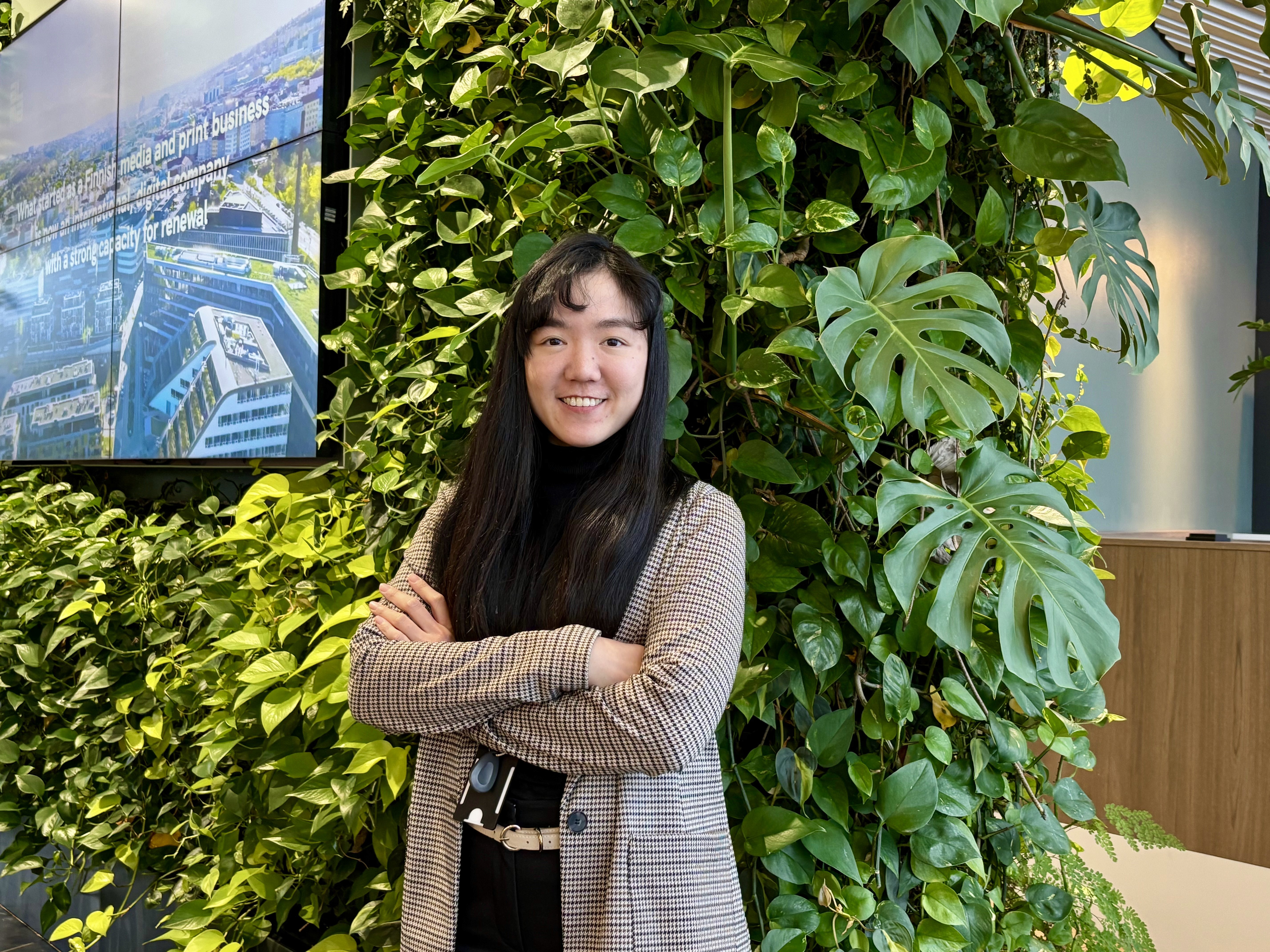
My name is Weerin, and I come from Bangkok, Thailand. Currently, I work as an AI Engineer at Alma Media. I’ve been living in Finland for over six years.
My daily work revolves around GenAI and machine learning for business applications. One of the key projects I’ve developed is a conversational analytics chatbot, “Ask from Data,” which allows users to interact with complex datasets in natural language. By combining generative AI with structured data models, business teams can easily explore insights such as user traffic trends, growth metrics, and performance comparisons over time.
Beyond this, I’ve contributed to improving search functionality, building models to detect suspicious user behaviour, and enhancing recommendation systems to deliver more personalized and engaging content.
My Path to Finland
My journey into AI wasn’t a straight line. It started at a business school in Thailand, where I initially set out to become an actuary in the insurance and finance institution. While studying statistics, I quickly realized that traditional financial modelling felt too rigid for me.
Everything changed when I took my first programming course. Writing simple programs in C++ opened a new world. For the first time, I could create and not just calculate. I built small tools, experimented, and felt something new. That was my turning point.
This curiosity led me to explore courses beyond my major and gain hands-on experience through internships in digital marketing, where I worked with platforms such as Google Ads and Facebook Ads.
Analysing campaign performance and optimizing results gave me a sense of excitement that confirmed my interest in data-driven creativity. That’s when I connected the dots and began shifting my path toward data science, a decision that ultimately shaped my career in AI today.
After working in e-commerce in Thailand for two years, I moved to Finland to pursue a Master’s degree in Data Science at Tampere University. When I started my Master’s, I didn’t have a clear roadmap to becoming an AI Engineer. What I did have was follow my curiosity and a willingness to try things, even when I wasn’t fully ready.
Learning by doing (Before Graduating)
During my studies at Tampere University, I didn’t wait until graduation to gain experience. I worked remotely for a start up in Helsinki as a data trainee, where I worked on web crawling and data collection from online marketplaces. It wasn't completely match with my end goal to become a data scientist at that time but it allows me to work in a fascinating business area: a fraud detection engine powered by large-scale online data collection. It allows me to see how data can create an impactful business value.
After graduating, I joined a Nordic bank as a Quantitative Risk Analyst. On paper, it was a perfect match; my background in statistics and mathematical finance aligned seamlessly with the role. It allowed me to dive into credit risk and observe how financial modelling integrates with economic factors to create stress test simulations. However, the work was heavily finance-focused and less room for creative problem solving for me. I know I wasn't that right person for it. After about six months, I made a decision many people hesitate to make: I changed direction.
Connecting the dots
After that, I joined a US-based life science regulatory solutions company, as a Machine Learning Engineer, working remotely from Finland. This opportunity came through a connection. A former classmate knew of my interest and experience with Natural Language Processing (NLP) and referred me. That’s when everything started to align.
Looking back, there’s a clear pattern in my journey: my strong interest in Natural Language Processing (NLP). I am fascinated by how computers can be taught to understand human language. My Bachelor’s thesis was about NLP for insurance brand monitoring. My Master’s thesis also focused on NLP using transformer models on healthcare data, and my first ML role involved NLP-focused projects.
Around 2022, AI tools like ChatGPT changed the landscape. Suddenly, many NLP tasks that once required time and resources in model fine-tuning for only a specific use case could be done faster and more efficiently.
Instead of replacing my role, it helps expanding my work. I shifted from tuning NLP models to designing GenAI-powered applications, experimenting with Generative AI, and solving real business problems with the powerful large language models. I worked in this space for about three years, gaining hands-on experience that would define my next step.
With that experience, I transitioned into my current role at Alma Media. I wasn’t just someone who understood models anymore; I was someone who could connect data, business needs, and AI, build real-world applications, and explore what’s possible with emerging technology.
My Advice for Anyone Entering AI Today
AI is a major enabler today. AI is making intelligence more accessible. I feel like intelligence is becoming a commodity.
In the past, only the most talented computer science students could handle complex programming. Today, AI can help almost anyone to start writing code and initiate their own project without a computer science degree. Even though it may not perfectly a production ready app (yet). But, for sure, it can help transforming idea into something tangible. It allows us to focus on building rather than exhausting mental bandwidth on complex algorithms.
However, AI is just a tool. The real advantage of AI will go to the people who know how to use it and know what is worth building in the first place. The biggest value is not just building things but knowing what is the right thing to build.
To thrive in an AI-driven world, I believe we need to be specialists with a wide lens. I encourage people to build T-shaped skills; deep expertise to guide the AI, and broad knowledge to solve real-world problems. AI can handle the "junior" work, but it still lacks the senior intuition needed to make things truly useful. My own edge came from an unexpected place: moving from studying insurance at a business school to developing AI. It seemed like a leap, but it was actually a bridge. My deep expertise is now in machine learning and AI, but I still carry the business knowledge from where I started, and that combination is what makes my work meaningful. I understand not just how to build AI, but where it actually fits in the real world of business.
I encourage every professional to not just learn AI, but to use AI to amplify the unique competitive edge we already have.
How I Stay Updated
Let’s be honest, keeping up with AI today is demanding: new models, new tools, new “breakthroughs” every week. I don’t try to follow everything. Instead, I focus on sources that are directly relevant to what I use.
For example, if I’m using Claude, I follow official updates and content from its developers. If I’m working with vector databases like Weaviate, I follow their team (CEO, CTO, engineers). They are likely to update their products on either Linkedin or X. It’s also a great way to train the recommendation algorithm: the more I like, save or share this type of content, the more my feed becomes a curated research tool tailored to my interests.
Instead of trying to keep up all the time, I set a simple rule: I spend about 30 minutes to one hour a day (after work) staying updated with AI news and doing my own research to deep drive into the topic I’m interested it. That’s it. No distractions during deep work.
Work-Life Balance
I’m a big fan of thought-provoking non-fiction books. It allows me think and see from different angles. One author I often return to is Malcolm Gladwell, known for books like Outliers, The Tipping Point. Another book that resonated with me is Factfulness by Hans Rosling. What I remember from the book was how our 'negativity instinct' convinces us the world is getting worse. In reality, we often miss the steady progress happening every day; the world is actually safer, healthier, and fairer than ever before if we compare it to an ancient time for example. Because that change is gradual, it's easy to overlook.
I also enjoy doing exercise to keep my body in balance with my mind. Recently, I’ve started Pilates classes (especially Megaformer), which I jokingly call a “torture machine.” It’s intense: combining strength, balance, and flexibility. Running has become a big part of my routine; it helps me reset and clear my mind.


May 25, 2026
Role Model Blog: Weerin Wongwarawipatr, Alma Media
“I encourage every professional to not just learn AI, but to use AI to amplify the unique competitive edge we already have.”
My name is Weerin, and I come from Bangkok, Thailand. Currently, I work as an AI Engineer at Alma Media. I’ve been living in Finland for over six years.
My daily work revolves around GenAI and machine learning for business applications. One of the key projects I’ve developed is a conversational analytics chatbot, “Ask from Data,” which allows users to interact with complex datasets in natural language. By combining generative AI with structured data models, business teams can easily explore insights such as user traffic trends, growth metrics, and performance comparisons over time.
Beyond this, I’ve contributed to improving search functionality, building models to detect suspicious user behaviour, and enhancing recommendation systems to deliver more personalized and engaging content.
My Path to Finland
My journey into AI wasn’t a straight line. It started at a business school in Thailand, where I initially set out to become an actuary in the insurance and finance institution. While studying statistics, I quickly realized that traditional financial modelling felt too rigid for me.
Everything changed when I took my first programming course. Writing simple programs in C++ opened a new world. For the first time, I could create and not just calculate. I built small tools, experimented, and felt something new. That was my turning point.
This curiosity led me to explore courses beyond my major and gain hands-on experience through internships in digital marketing, where I worked with platforms such as Google Ads and Facebook Ads.
Analysing campaign performance and optimizing results gave me a sense of excitement that confirmed my interest in data-driven creativity. That’s when I connected the dots and began shifting my path toward data science, a decision that ultimately shaped my career in AI today.
After working in e-commerce in Thailand for two years, I moved to Finland to pursue a Master’s degree in Data Science at Tampere University. When I started my Master’s, I didn’t have a clear roadmap to becoming an AI Engineer. What I did have was follow my curiosity and a willingness to try things, even when I wasn’t fully ready.
Learning by doing (Before Graduating)
During my studies at Tampere University, I didn’t wait until graduation to gain experience. I worked remotely for a start up in Helsinki as a data trainee, where I worked on web crawling and data collection from online marketplaces. It wasn't completely match with my end goal to become a data scientist at that time but it allows me to work in a fascinating business area: a fraud detection engine powered by large-scale online data collection. It allows me to see how data can create an impactful business value.
After graduating, I joined a Nordic bank as a Quantitative Risk Analyst. On paper, it was a perfect match; my background in statistics and mathematical finance aligned seamlessly with the role. It allowed me to dive into credit risk and observe how financial modelling integrates with economic factors to create stress test simulations. However, the work was heavily finance-focused and less room for creative problem solving for me. I know I wasn't that right person for it. After about six months, I made a decision many people hesitate to make: I changed direction.
Connecting the dots
After that, I joined a US-based life science regulatory solutions company, as a Machine Learning Engineer, working remotely from Finland. This opportunity came through a connection. A former classmate knew of my interest and experience with Natural Language Processing (NLP) and referred me. That’s when everything started to align.
Looking back, there’s a clear pattern in my journey: my strong interest in Natural Language Processing (NLP). I am fascinated by how computers can be taught to understand human language. My Bachelor’s thesis was about NLP for insurance brand monitoring. My Master’s thesis also focused on NLP using transformer models on healthcare data, and my first ML role involved NLP-focused projects.
Around 2022, AI tools like ChatGPT changed the landscape. Suddenly, many NLP tasks that once required time and resources in model fine-tuning for only a specific use case could be done faster and more efficiently.
Instead of replacing my role, it helps expanding my work. I shifted from tuning NLP models to designing GenAI-powered applications, experimenting with Generative AI, and solving real business problems with the powerful large language models. I worked in this space for about three years, gaining hands-on experience that would define my next step.
With that experience, I transitioned into my current role at Alma Media. I wasn’t just someone who understood models anymore; I was someone who could connect data, business needs, and AI, build real-world applications, and explore what’s possible with emerging technology.
My Advice for Anyone Entering AI Today
AI is a major enabler today. AI is making intelligence more accessible. I feel like intelligence is becoming a commodity.
In the past, only the most talented computer science students could handle complex programming. Today, AI can help almost anyone to start writing code and initiate their own project without a computer science degree. Even though it may not perfectly a production ready app (yet). But, for sure, it can help transforming idea into something tangible. It allows us to focus on building rather than exhausting mental bandwidth on complex algorithms.
However, AI is just a tool. The real advantage of AI will go to the people who know how to use it and know what is worth building in the first place. The biggest value is not just building things but knowing what is the right thing to build.
To thrive in an AI-driven world, I believe we need to be specialists with a wide lens. I encourage people to build T-shaped skills; deep expertise to guide the AI, and broad knowledge to solve real-world problems. AI can handle the "junior" work, but it still lacks the senior intuition needed to make things truly useful. My own edge came from an unexpected place: moving from studying insurance at a business school to developing AI. It seemed like a leap, but it was actually a bridge. My deep expertise is now in machine learning and AI, but I still carry the business knowledge from where I started, and that combination is what makes my work meaningful. I understand not just how to build AI, but where it actually fits in the real world of business.
I encourage every professional to not just learn AI, but to use AI to amplify the unique competitive edge we already have.
How I Stay Updated
Let’s be honest, keeping up with AI today is demanding: new models, new tools, new “breakthroughs” every week. I don’t try to follow everything. Instead, I focus on sources that are directly relevant to what I use.
For example, if I’m using Claude, I follow official updates and content from its developers. If I’m working with vector databases like Weaviate, I follow their team (CEO, CTO, engineers). They are likely to update their products on either Linkedin or X. It’s also a great way to train the recommendation algorithm: the more I like, save or share this type of content, the more my feed becomes a curated research tool tailored to my interests.
Instead of trying to keep up all the time, I set a simple rule: I spend about 30 minutes to one hour a day (after work) staying updated with AI news and doing my own research to deep drive into the topic I’m interested it. That’s it. No distractions during deep work.
Work-Life Balance
I’m a big fan of thought-provoking non-fiction books. It allows me think and see from different angles. One author I often return to is Malcolm Gladwell, known for books like Outliers, The Tipping Point. Another book that resonated with me is Factfulness by Hans Rosling. What I remember from the book was how our 'negativity instinct' convinces us the world is getting worse. In reality, we often miss the steady progress happening every day; the world is actually safer, healthier, and fairer than ever before if we compare it to an ancient time for example. Because that change is gradual, it's easy to overlook.
I also enjoy doing exercise to keep my body in balance with my mind. Recently, I’ve started Pilates classes (especially Megaformer), which I jokingly call a “torture machine.” It’s intense: combining strength, balance, and flexibility. Running has become a big part of my routine; it helps me reset and clear my mind.
May 25, 2026
Role Model Blog: Weerin Wongwarawipatr, Alma Media
“I encourage every professional to not just learn AI, but to use AI to amplify the unique competitive edge we already have.”
My name is Weerin, and I come from Bangkok, Thailand. Currently, I work as an AI Engineer at Alma Media. I’ve been living in Finland for over six years.
My daily work revolves around GenAI and machine learning for business applications. One of the key projects I’ve developed is a conversational analytics chatbot, “Ask from Data,” which allows users to interact with complex datasets in natural language. By combining generative AI with structured data models, business teams can easily explore insights such as user traffic trends, growth metrics, and performance comparisons over time.
Beyond this, I’ve contributed to improving search functionality, building models to detect suspicious user behaviour, and enhancing recommendation systems to deliver more personalized and engaging content.
My Path to Finland
My journey into AI wasn’t a straight line. It started at a business school in Thailand, where I initially set out to become an actuary in the insurance and finance institution. While studying statistics, I quickly realized that traditional financial modelling felt too rigid for me.
Everything changed when I took my first programming course. Writing simple programs in C++ opened a new world. For the first time, I could create and not just calculate. I built small tools, experimented, and felt something new. That was my turning point.
This curiosity led me to explore courses beyond my major and gain hands-on experience through internships in digital marketing, where I worked with platforms such as Google Ads and Facebook Ads.
Analysing campaign performance and optimizing results gave me a sense of excitement that confirmed my interest in data-driven creativity. That’s when I connected the dots and began shifting my path toward data science, a decision that ultimately shaped my career in AI today.
After working in e-commerce in Thailand for two years, I moved to Finland to pursue a Master’s degree in Data Science at Tampere University. When I started my Master’s, I didn’t have a clear roadmap to becoming an AI Engineer. What I did have was follow my curiosity and a willingness to try things, even when I wasn’t fully ready.
Learning by doing (Before Graduating)
During my studies at Tampere University, I didn’t wait until graduation to gain experience. I worked remotely for a start up in Helsinki as a data trainee, where I worked on web crawling and data collection from online marketplaces. It wasn't completely match with my end goal to become a data scientist at that time but it allows me to work in a fascinating business area: a fraud detection engine powered by large-scale online data collection. It allows me to see how data can create an impactful business value.
After graduating, I joined a Nordic bank as a Quantitative Risk Analyst. On paper, it was a perfect match; my background in statistics and mathematical finance aligned seamlessly with the role. It allowed me to dive into credit risk and observe how financial modelling integrates with economic factors to create stress test simulations. However, the work was heavily finance-focused and less room for creative problem solving for me. I know I wasn't that right person for it. After about six months, I made a decision many people hesitate to make: I changed direction.
Connecting the dots
After that, I joined a US-based life science regulatory solutions company, as a Machine Learning Engineer, working remotely from Finland. This opportunity came through a connection. A former classmate knew of my interest and experience with Natural Language Processing (NLP) and referred me. That’s when everything started to align.
Looking back, there’s a clear pattern in my journey: my strong interest in Natural Language Processing (NLP). I am fascinated by how computers can be taught to understand human language. My Bachelor’s thesis was about NLP for insurance brand monitoring. My Master’s thesis also focused on NLP using transformer models on healthcare data, and my first ML role involved NLP-focused projects.
Around 2022, AI tools like ChatGPT changed the landscape. Suddenly, many NLP tasks that once required time and resources in model fine-tuning for only a specific use case could be done faster and more efficiently.
Instead of replacing my role, it helps expanding my work. I shifted from tuning NLP models to designing GenAI-powered applications, experimenting with Generative AI, and solving real business problems with the powerful large language models. I worked in this space for about three years, gaining hands-on experience that would define my next step.
With that experience, I transitioned into my current role at Alma Media. I wasn’t just someone who understood models anymore; I was someone who could connect data, business needs, and AI, build real-world applications, and explore what’s possible with emerging technology.
My Advice for Anyone Entering AI Today
AI is a major enabler today. AI is making intelligence more accessible. I feel like intelligence is becoming a commodity.
In the past, only the most talented computer science students could handle complex programming. Today, AI can help almost anyone to start writing code and initiate their own project without a computer science degree. Even though it may not perfectly a production ready app (yet). But, for sure, it can help transforming idea into something tangible. It allows us to focus on building rather than exhausting mental bandwidth on complex algorithms.
However, AI is just a tool. The real advantage of AI will go to the people who know how to use it and know what is worth building in the first place. The biggest value is not just building things but knowing what is the right thing to build.
To thrive in an AI-driven world, I believe we need to be specialists with a wide lens. I encourage people to build T-shaped skills; deep expertise to guide the AI, and broad knowledge to solve real-world problems. AI can handle the "junior" work, but it still lacks the senior intuition needed to make things truly useful. My own edge came from an unexpected place: moving from studying insurance at a business school to developing AI. It seemed like a leap, but it was actually a bridge. My deep expertise is now in machine learning and AI, but I still carry the business knowledge from where I started, and that combination is what makes my work meaningful. I understand not just how to build AI, but where it actually fits in the real world of business.
I encourage every professional to not just learn AI, but to use AI to amplify the unique competitive edge we already have.
How I Stay Updated
Let’s be honest, keeping up with AI today is demanding: new models, new tools, new “breakthroughs” every week. I don’t try to follow everything. Instead, I focus on sources that are directly relevant to what I use.
For example, if I’m using Claude, I follow official updates and content from its developers. If I’m working with vector databases like Weaviate, I follow their team (CEO, CTO, engineers). They are likely to update their products on either Linkedin or X. It’s also a great way to train the recommendation algorithm: the more I like, save or share this type of content, the more my feed becomes a curated research tool tailored to my interests.
Instead of trying to keep up all the time, I set a simple rule: I spend about 30 minutes to one hour a day (after work) staying updated with AI news and doing my own research to deep drive into the topic I’m interested it. That’s it. No distractions during deep work.
Work-Life Balance
I’m a big fan of thought-provoking non-fiction books. It allows me think and see from different angles. One author I often return to is Malcolm Gladwell, known for books like Outliers, The Tipping Point. Another book that resonated with me is Factfulness by Hans Rosling. What I remember from the book was how our 'negativity instinct' convinces us the world is getting worse. In reality, we often miss the steady progress happening every day; the world is actually safer, healthier, and fairer than ever before if we compare it to an ancient time for example. Because that change is gradual, it's easy to overlook.
I also enjoy doing exercise to keep my body in balance with my mind. Recently, I’ve started Pilates classes (especially Megaformer), which I jokingly call a “torture machine.” It’s intense: combining strength, balance, and flexibility. Running has become a big part of my routine; it helps me reset and clear my mind.